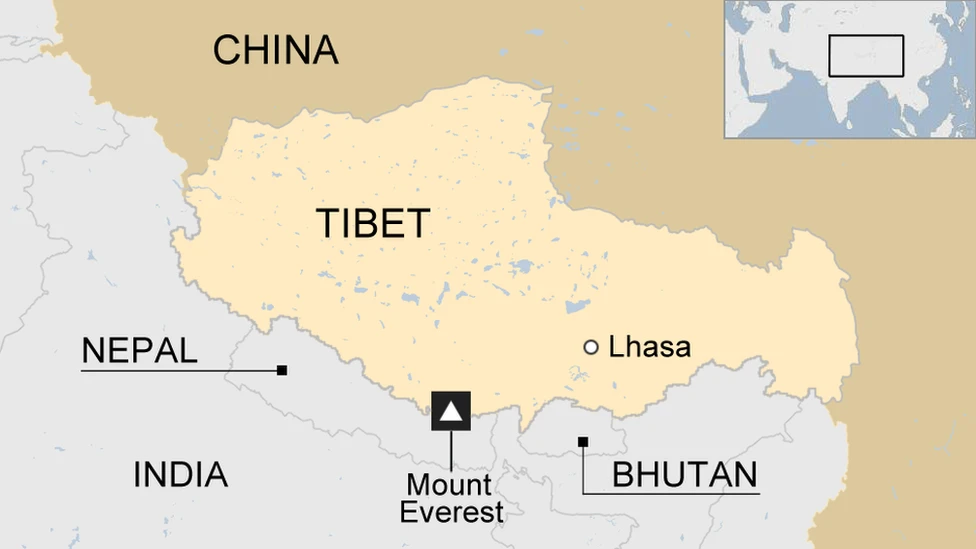
Historically, Tibet was made up of three major areas - U-Tsang, Amdo and Kham. While most of U-Tsang is in China's self-defined Tibet Autonomous Region, the other two lie outside it.
Tibet's history includes periods when it was an independent entity and other times when it was ruled by powerful Chinese and Mongolian dynasties.
Beijing claims a centuries-old sovereignty over Tibet. However, this Chinese view of imperial rule over Tibet spanning many centuries is disputed by exiled Tibetan communities and rights groups.
The allegiances of many Tibetans lie with the exiled spiritual leader, the Dalai Lama, who is seen by his followers as a living god but by Beijing as a separatist threat.
In 1950, China sent in thousands of troops to enforce its claim on Tibet. In 1959, after a failed anti-Chinese uprising, the Dalai Lama fled and set up a government in exile in India. Many of Tibet's monasteries were destroyed during China's Cultural Revolution.
Thousands of Tibetans are believed to have been killed during periods of repression and martial law. While Tibetans' standard of living has greatly improved, Tibet remains tightly controlled by Chinese authorities.
Taiwan
Tibet, the remote and mainly-Buddhist territory known as the "roof of the world", is governed as part of China.
No comments yet. Be the first to comment.